
Greece Multi-Day Tours with Flights from €1,220
Athens and the Acropolis, Meteora's monasteries, the Santorini caldera and a ferry through the Cyclades. One bundled price, two quick bookings.
Edited by Multiday.tours editor
- ✓Entry price around €1,220 per person for a guided 5-7 day Greece tour
- ✓Typical 8-10 day mainland + islands trip €1,890 before flights
- ✓European return flights to Athens €90-€350 depending on season
- ✓Best months: May, June, September, early October
- ✓Operators: Dot Travel, Travel Zone, Click Tours, G Adventures, Intrepid
- ✓Peak July-August adds 30-40% and 35-40°C heat
Greece comes in two shapes, and most travellers fall for one or the other. There is the mainland loop through Athens, Delphi, Meteora and the Peloponnese, all ancient stone and big landscapes; and there is the island-hopping run across Santorini, Mykonos and Crete, all ferries and caldera sunsets. A guided multi-day trip starts from around €1,220 per person (tour only, no flight), a typical 8-10 day trip lands near €1,890, and the longer semi-private or four-island itineraries climb past €2,770. Dot Travel, Travel Zone, Click Tours and G Adventures do most of the running, with Expat Explore and Fez Travel holding down the coach-tour end. Fold in a return flight from a European hub and a proper 10 days comes to €1,500 to €2,600 all-in. Below: the real itineraries, how the ferries actually work, the flight gateways that save you a day, and when to go.
The tours doing the heavy lifting here
Prices are tour-only — add flights for the real total. You book the tour itself on TourRadar.
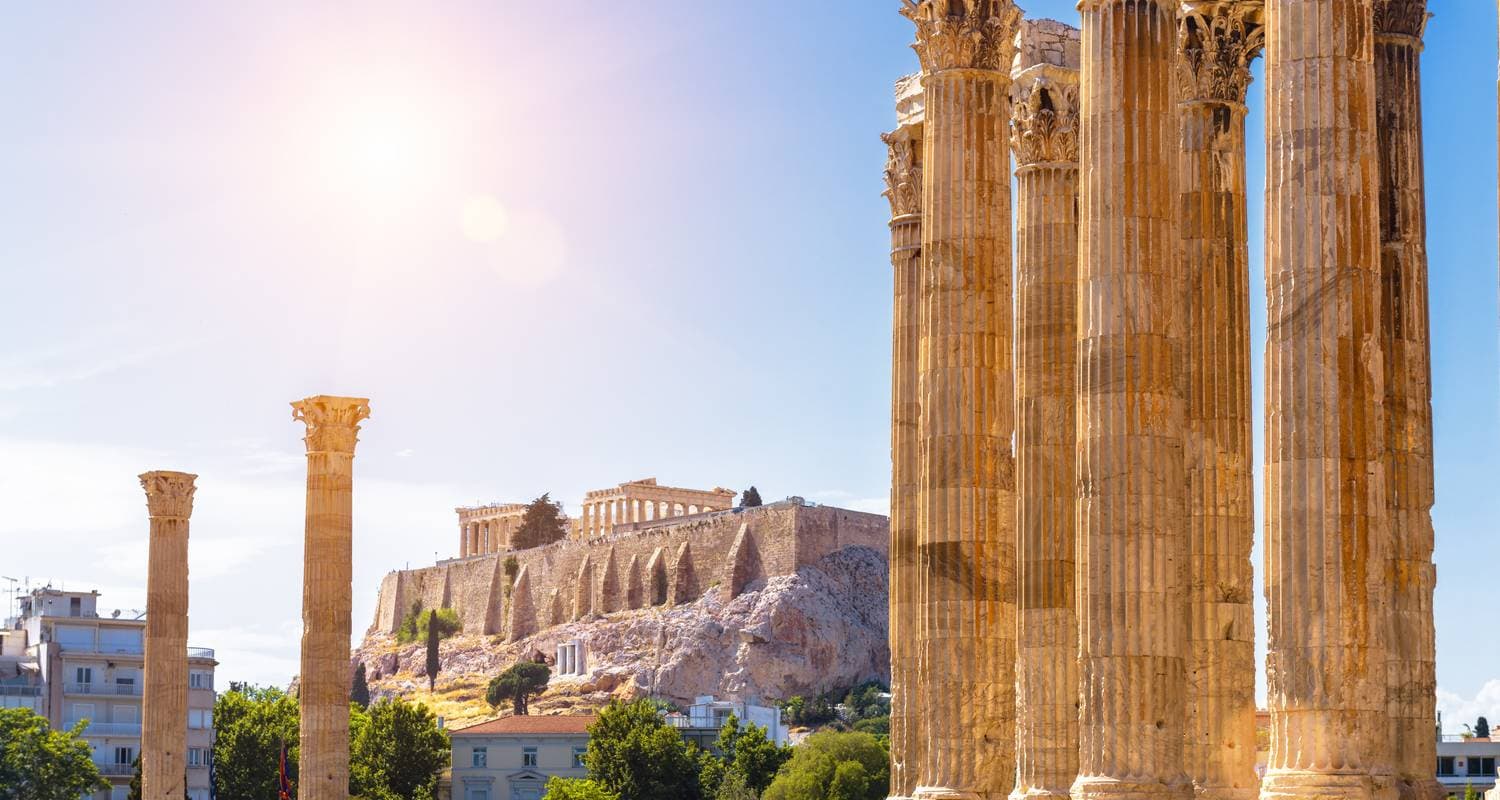
Greek Island Hopping (Plus)
11 days · Contiki
4.8· 812 reviews✓ Instant confirmationtour from €1,813
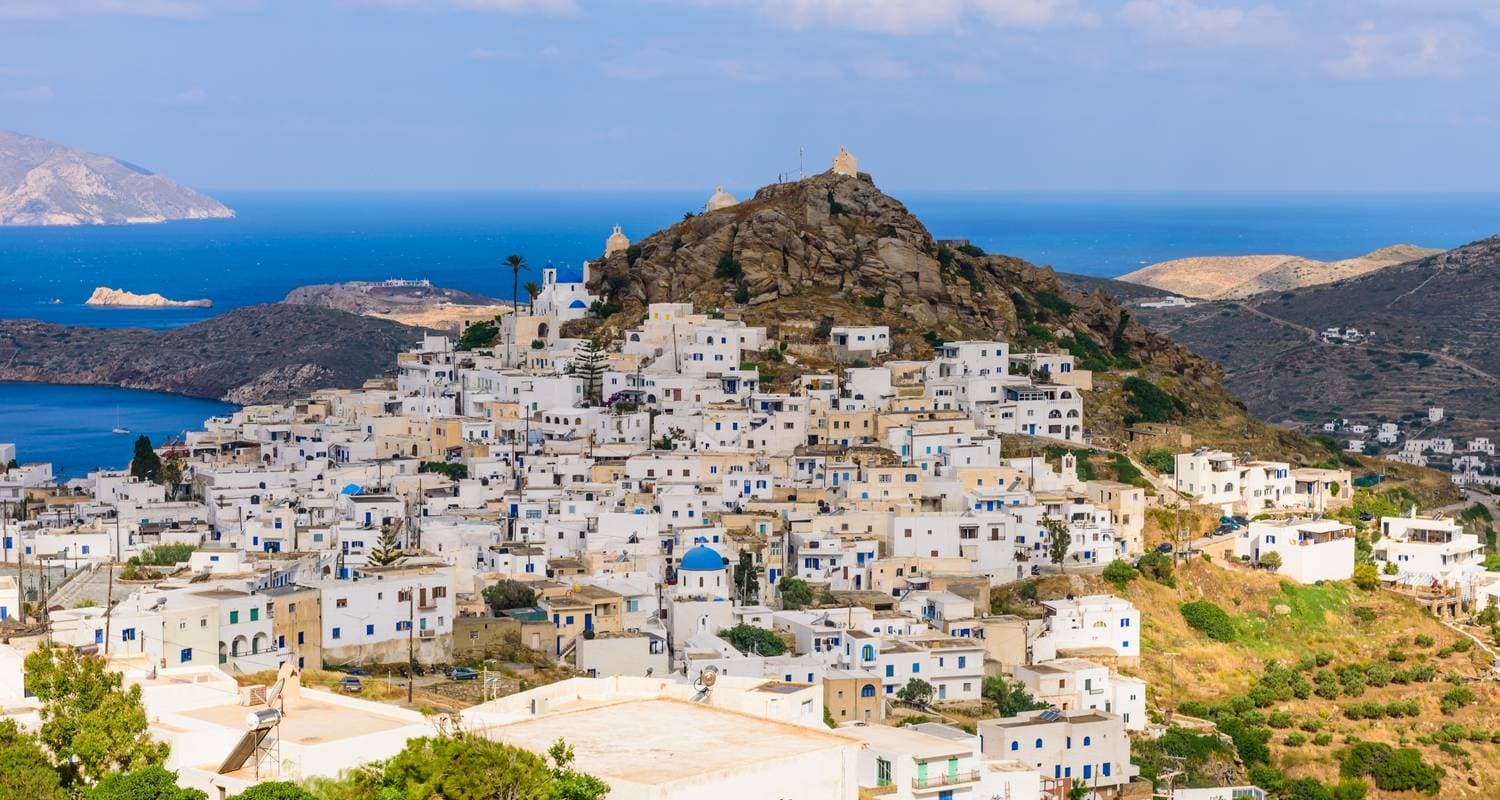
Greek Island Hopping (Standard)
11 days · Contiki
4.8· 812 reviews✓ Instant confirmationtour from €1,357
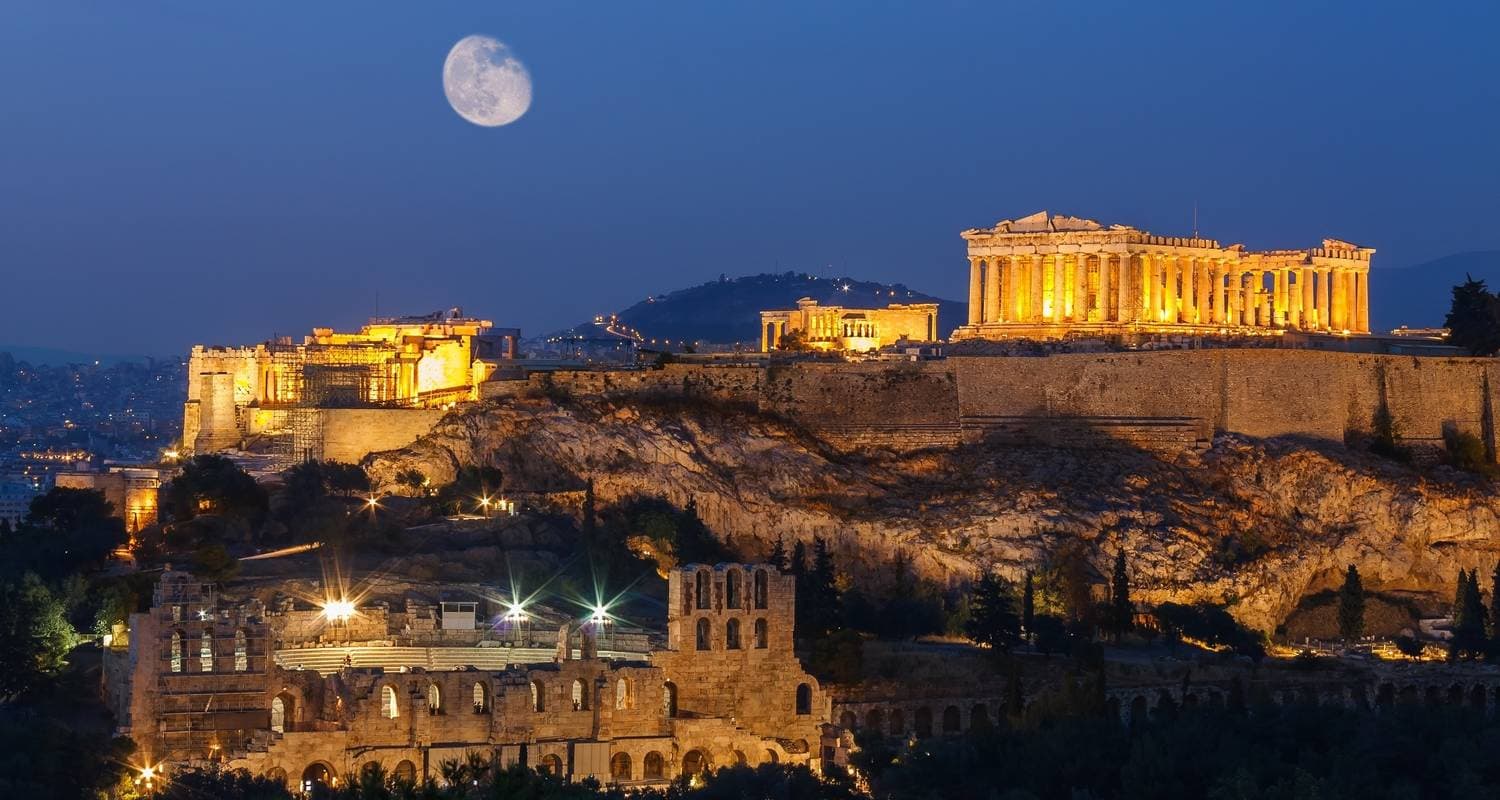
Best of Greece
10 days · Travel Talk
4.7· 197 reviewstour from €3,413
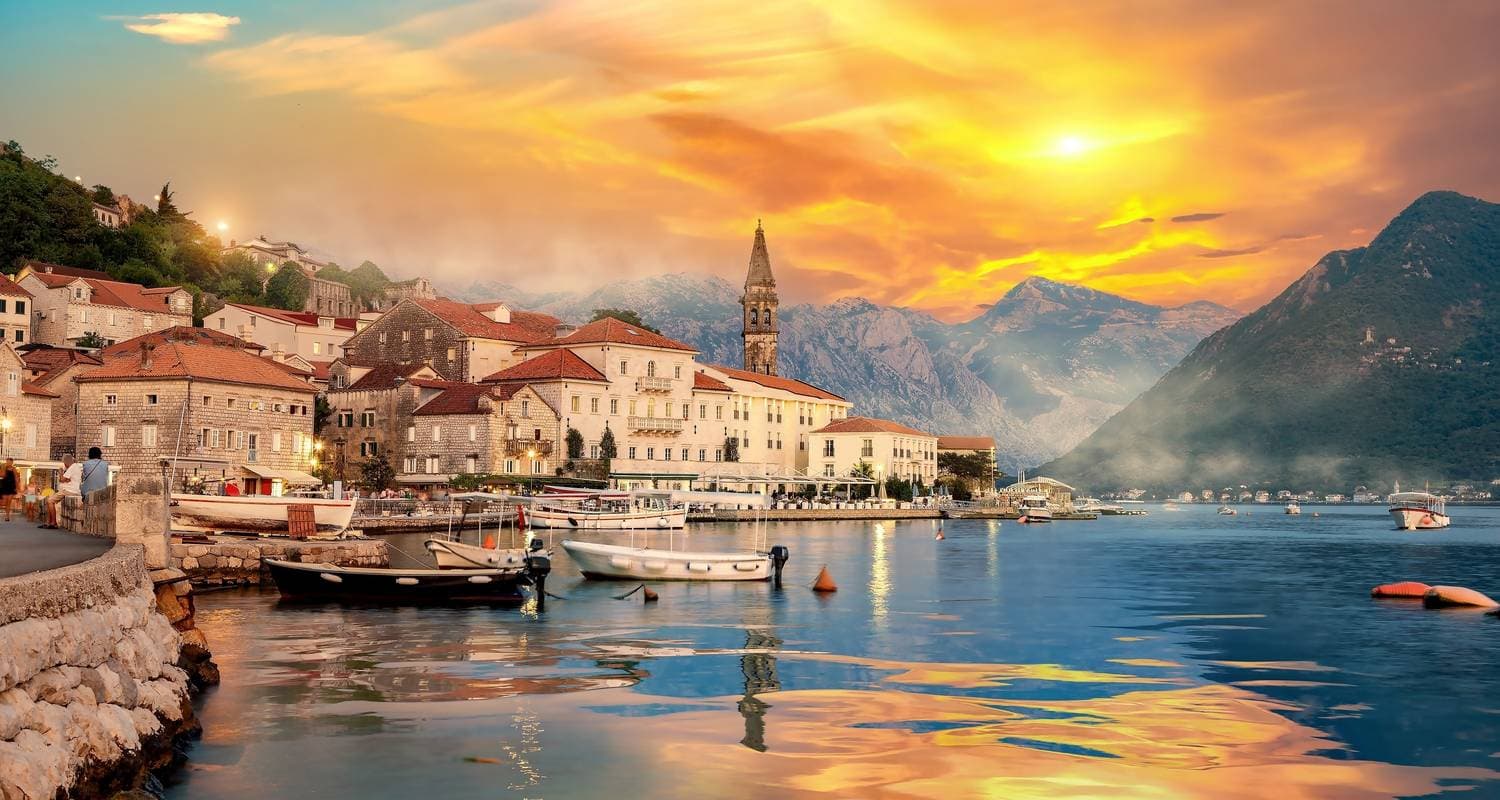
All About Balkans (4 Star Hotels)
12 days · Travel Talk
4.7· 193 reviewstour from €3,300

Greece Island Hopper
9 days · TruTravels
4.7· 169 reviews✓ Instant confirmationtour from €2,254
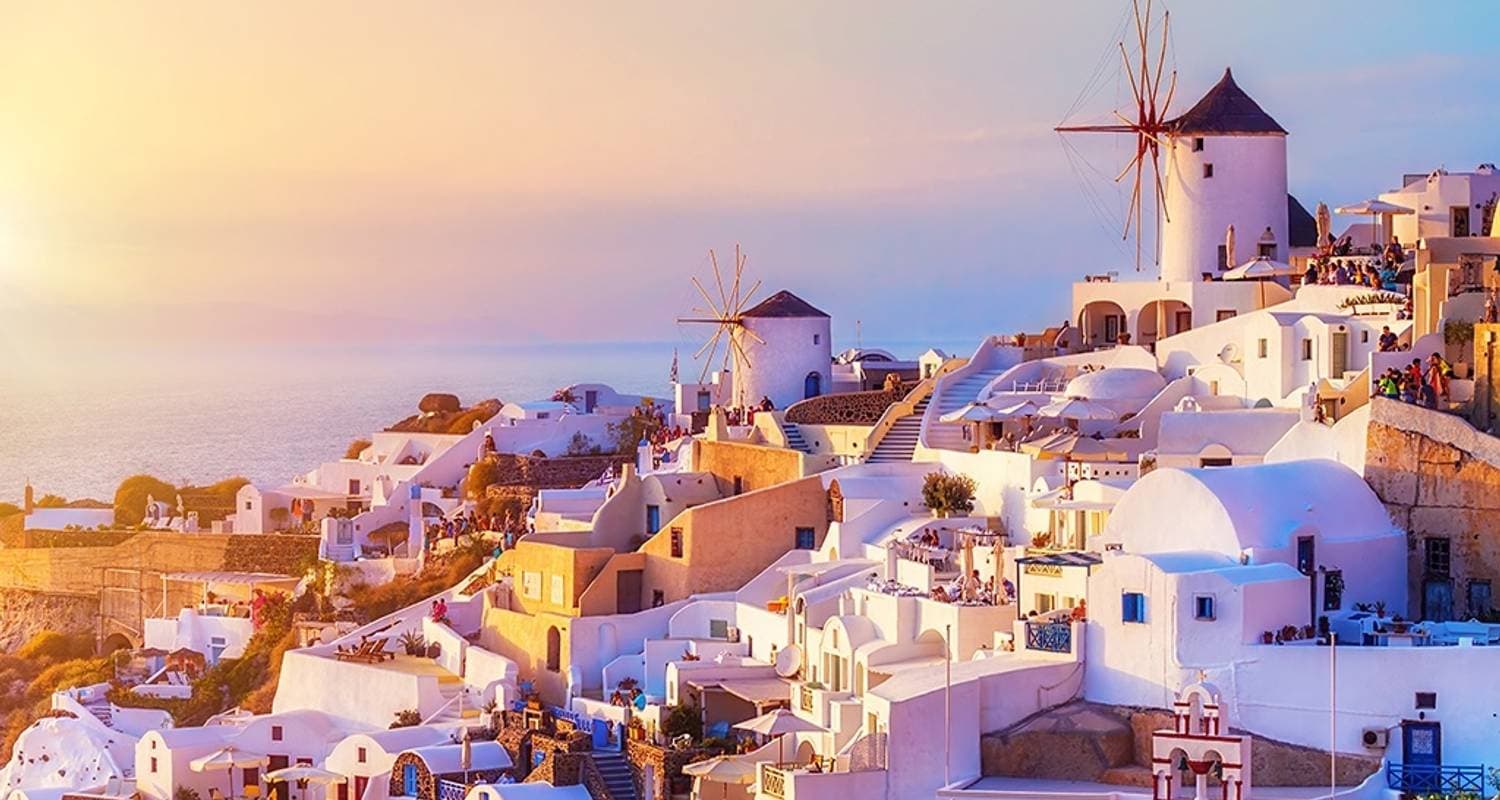
Greek Island Hopping | Semi guided Tour | 11 Days
11 days · Travel Zone
4.7· 127 reviews✓ Instant confirmationtour from €2,685
Mainland classics: Athens, Delphi, Meteora and the Peloponnese
The mainland tour is the one first-timers tend to underrate, and they are wrong to. A 7-10 day classical itinerary opens with two nights in Athens for the Acropolis, the Acropolis Museum and an evening in the Plaka, then heads west into the Peloponnese for Corinth, Mycenae, Epidaurus and Nafplion. From there you climb north to Olympia, cross to Delphi on the slopes of Mount Parnassos, and finish at Meteora, where six working monasteries perch on top of sandstone pillars.
Destination Services Greece runs a solid 5-day Classical Tour (Nafplion, Olympia, Delphi, Meteora) from around €1,020 per person, and Fez Travel's 7-day Greece Classic Tour lands near €1,560. Click Tours' 8-day Highlights of Greece sits around €2,350 with smarter hotels and smaller groups. What you get on any of them: a licensed Greek guide at each archaeological site (the law requires it inside Meteora and most major ruins), coach transfers, breakfast daily, and 3-star or 4-star hotels.
What you do not get: lunches, dinners, and the €30-€50 in site entry fees on free days. Set aside €200-€300 for a week of meals on your own coin. And if you only get one shot at Greece, do mainland plus two islands in 10 days; the pure mainland loops are the richer trip, but they cost you the beach afternoons most travellers quietly want.
Island-hopping: Santorini, Mykonos, Crete and ferries
The default island combo is Santorini and Mykonos, usually three nights on each. Add Crete and you need a week. Add Naxos or Paros and you are into 10 days. Dot Travel's self-guided 7-day Athens, Mykonos and Santorini lands around €1,070, their 15-day Best of Greece with four islands sits near €1,940, and Travel Zone's 10-day semi-private Athens, Santorini and Mykonos with three guided tours comes in at €3,160.
Ferries or flights is the decision that shapes everything else. Blue Star and Hellenic Seaways run the slow open-deck ferries (5-8 hours, €40-€60), and Seajets run the high-speed catamarans (2-4 hours, €60-€100). Piraeus to Santorini direct is 5 hours on Seajets, 8 on the slow boat. Santorini to Mykonos is 2-3 hours high-speed. Flying Athens to Santorini (JTR) or Mykonos (JMK) on Aegean or Sky Express takes 45 minutes and runs €60-€120 if you book a few weeks out.
Rule of thumb: take a ferry at least once, because the Cyclades look like a different country from sea level, but fly the longest leg if the clock is against you. Crete connects to Santorini by catamaran in 2 hours, so a proper three-island loop is Athens, Santorini, Crete, then home from Heraklion (HER) on Ryanair or easyJet.
Coach tour vs small-group vs sailing: picking your style
Coach tours are the cheapest way to see Greece in a straight line. Expat Explore runs 14-16 day Balkan Explorer routes that take in Greece for around €3,100, with 40-50 people on the bus, 3-star hotels and a packed schedule. Trafalgar and Insight Vacations work the polished end of the same format at €2,500-€4,000 for a 10-day Greece tour.
Small-group tours of 12-16 people are the sweet spot for most travellers. G Adventures runs a well-loved 8-day Sailing Greece trip through the Cyclades on a crewed yacht for roughly €1,200-€1,500 before flights, plus an 8-day Greece Island Hopper at around €1,300. Intrepid's Best of Greece and Real Greece runs cover both mainland and islands at €1,400-€2,100, and Exodus has a 9-day Classical Greece walking trip if you want some hiking through Delphi and the Peloponnese in the mix.
Food-focused trips are a small but reliable corner of the market. Intrepid's Real Food Adventure Greece (8 days, €1,800) builds every day around a cooking class, a market or a long lunch. Contiki and Topdeck handle the 18-35 sailing scene on flotilla-style trips through the Saronic Gulf and Ionian islands at €1,200-€1,700 for a week. Private and luxury sailing charters start at €4,000 per cabin per week and climb from there.
Best time to go: sweet spots and the July-August wall
Greek peak is July and August, and it is genuinely overcooked: 35-40°C on the islands, cruise ships emptying thousands onto Santorini's caldera paths by 11am, and ferry prices up 30-40%. Give it a miss unless the calendar pins you to it.
May, June, September and early October are the sweet spot. Daytime highs of 24-28°C, a sea warm enough to swim in (22-24°C from mid-June, warmest in September), and ferry and hotel prices 20-30% below August. Late September might be the single best week of the year: quieter beaches, water still warm, and Delphi and Olympia at the perfect temperature for walking.
April and early May run cool, 16-22°C, and some beach clubs are not yet open, but it is the cheapest shoulder and the mainland is at its greenest. The olive groves are in bloom, spring wildflowers wash over the Peloponnese, and Greek Orthodox Easter (12 April 2026) is a genuine event worth planning a trip around.
November to March is off-season and mostly not worth it for the islands: ferry schedules thin to two or three sailings a week, half the Santorini and Mykonos hotels close, and the weather swings from 12°C and rain to the odd dusting of snow on the higher peaks. Athens and Meteora stay open year-round, though, and are a quiet pleasure in January if mainland culture is all you are after.
Getting to Greece: flights from the US, Australia, Canada and Europe
Athens (ATH) is the main gateway whatever your origin, with Thessaloniki (SKG) and the island airports useful for specific routes.
From the US, Athens has become a strong direct market in summer. The East Coast flies nonstop in the warm months: New York (JFK and EWR), Newark, Washington, Boston, Chicago, Philadelphia and Atlanta all run seasonal direct service to Athens on Delta, United, American, Emirates and Aegean, in around 10-11 hours, with one-stop routings through a European hub the rest of the year. Reckon on US$700-$1,050 return in the May-June and September-October shoulder, US$1,100-$1,600 over the July-August peak. From the West Coast (Los Angeles, San Francisco) expect one stop, 15-17 hours all in, at US$850-$1,400. Book three to five months out, and longer for high summer.
From Australia it is a long-haul with no nonstop, so you connect once through a Gulf hub (Emirates or Qatar via Dubai or Doha) or an Asian one (Singapore Airlines, Cathay), for roughly 22-24 hours door to door from Sydney, Melbourne or Brisbane. Return fares run around A$1,800-$2,600 in the shoulder and A$2,600-$3,400 over the December-January and mid-year peaks. A Dubai, Doha or Singapore stopover breaks the journey nicely on the way through.
From Canada, Air Canada flies Toronto and Montreal direct to Athens in summer (about 9-10 hours), with one-stop routings off-season and from Vancouver; budget roughly C$950-$1,600 return depending on season.
From the UK and the rest of Europe, fares are cheap and direct. From Dublin, London, Frankfurt, Paris, Amsterdam or Rome, reckon on €90-€180 return in shoulder season on Ryanair, Aegean, Wizz or easyJet, and €200-€350 in July and August. Aegean runs a dependable network across Europe with free checked bags on most fares, usually €30-€50 more than the budget lines for noticeably better service. Thessaloniki (SKG) is the smart play if your tour starts up north, whether that is a Meteora-first itinerary, a Halkidiki beach run or a Balkan combination; Ryanair and Wizz fly it from most Central European cities at €80-€140 return in shoulder season, sparing you the 4-hour coach transfer down from Athens. Flying straight to Santorini (JTR) or Mykonos (JMK) usually only pays off May to October on the European budget carriers' seasonal routes (€120-€220 return from London, Milan, Paris or Vienna), and Heraklion (HER) on Crete keeps Ryanair and easyJet year-round, often the single cheapest fare in the country.
The classic money-saver is the open-jaw: fly into Athens, ferry through the islands, and fly home from Santorini, Mykonos or Heraklion. Kiwi.com handles the multi-city routing on our bundles, and you see the full per-person trip price in your own currency before you commit to either the tour or the flight.
Ready to price your trip?
Enter your origin airport and month — we'll search live flight and tour prices and give you one bundled total per person.
Find combosCommon questions
How much does a 10-day Greece tour cost with flights?
Budget roughly €1,500-€2,600 per person all-in from most European cities. That stretches to a small-group tour (€1,200-€2,100 with guide, inter-island ferries or flights, hotels and most breakfasts), return flights from Europe to Athens (€90-€350 depending on the season), tips (€50-€80), plus spending money for lunches, dinners and ferry snacks (€300-€450). Semi-private and coach tours like Travel Zone's 10-day Athens, Santorini and Mykonos run closer to €3,500-€4,000 before flights, and sailing charters or luxury four-island itineraries push past €5,000.
Should I do the Greek mainland or the islands?
Both, if you have 10 days. The mainland (Athens, Delphi, Meteora, the Peloponnese) is where the archaeology and the big landscapes live, and it costs less by the day. The islands are where the food, the beaches and those caldera views wait. A 7-day trip forces the choice: mainland if you came for the history, islands if you came to swim and watch the sun go down. Ten days lets you fit in Athens, the mainland highlights and two islands, which is the sweet spot.
When is the cheapest time to visit Greece?
November to March for flights and mainland hotels (returns from €70-€120, hotels 40-50% below summer), though most islands all but close. The best-value window to actually travel is late April to mid-June, and again mid-September to late October: prices 20-30% below peak, the sea still swimmable, and the crowds noticeably thinner. August is peak in every sense, with prices, heat and ferry demand all at their limit. Avoid unless the school holidays have made the decision for you.
Is it better to ferry or fly between the Greek islands?
Ferries are cheaper, far more scenic, and let you see the Cyclades from sea level, so take at least one. Blue Star slow ferries cost €40-€60 and take 5-8 hours; Seajets catamarans run €60-€100 in 2-4 hours. Flights with Aegean or Sky Express take 45 minutes and cost €60-€120 booked a few weeks out. The trick is to fly the longest leg when time is tight (Athens to Santorini or Crete) and ferry the short hops (Santorini to Mykonos, Mykonos to Paros).
Is Greece safe for solo travellers?
Yes. Greece is one of the easier countries in Europe for solo travel, women included. Violent crime against tourists is very rare, the islands are sociable by nature, and English is spoken in any town a tour visits. Petty theft, mostly pickpocketing on the Athens metro and around Monastiraki, is the main thing to watch, and normal precautions see it off. Small-group tours with G Adventures, Intrepid and Dot Travel pull in plenty of solo travellers and usually offer twin-share with no single supplement. The islands in particular are a breeze to travel alone.
What should I pack for a Greece tour?
Real walking shoes or sturdy trainers for the Acropolis and Meteora, where the stone is polished and slippery in places and sandals are a misery on the archaeological sites. Light layers for May and October evenings, when it drops to 15-18°C, plus a proper sun hat and high-SPF sunscreen for summer, and modest shoulder-and-knee cover for the Meteora monasteries (they will lend you a wrap if you forget). Swimwear, a quick-dry towel and a refillable water bottle. Cards work almost everywhere, but carry €50-€100 in cash for tips, small tavernas and ferry snacks.
Related destinations
- Italy Multi-Day Tours with Flights from €1,750Rome, Florence and Venice in ten days, or a full Grand Tour …
- Turkey Multi-Day Tours with Flights from €1,000Cappadocia balloons at sunrise, the Blue Mosque at dusk, Pam…
- Croatia Multi-Day Tours with Flights from €1,165Split and Dubrovnik, Plitvice waterfalls, and a week of sail…
Related tour styles
Pick by trip length
Plan this trip from your city
- Multi-Day Tours from New York with Flights IncludedMulti-day tours from New York with flights included — one US…
- Multi-Day Tours from Los Angeles with Flights IncludedPackage tours from Los Angeles with flights included — one U…
- Multi-Day Tours from Sydney with Flights IncludedLeaving Australia means a long-haul flight whether you like …
- Multi-Day Tours from Toronto with Flights IncludedPearson is Canada's biggest long-haul hub, and with a weak l…
- Multi-Day Tours from London with Flights IncludedBuilt for London travellers: LHR for long-haul, LGW for Euro…
- Multi-Day Tours from Dublin with Flights IncludedPackage tours from Dublin with flights included — one total …
- Multi-Day Tours from Vienna with Flights IncludedVienna is a central-European hub on Austrian Airlines with d…
Deeper reading
- The Perfect 10-Day Greece Itinerary (Route, Day by Day)Ten days is the Greece sweet spot: Athens and the mainland c…
- How Much Does a Greece Tour Cost? The Honest All-In NumberA week to ten days in Greece runs roughly €1,500–€2,900 (≈$1…
- The Best Time to Visit Greece (Month-by-Month, 2026)May-June and Sep-Oct are the discover spots. July-August ove…